How Much Does a Great Website Cost in the UK? A Proper 2026 Breakdown

We've built over 70 websites in the past six years. In this article I'll tell you what a good one actually costs, the four mistakes I see businesses make most often, and exactly what we charge at Ambitions AI.
A few weeks ago, a veterinary practice client came to us in a very familiar state.
They had spent a significant sum on a brand new website the previous year. They were deeply, genuinely unhappy with it. When I asked them why, the answer came in two parts.
"It just doesn't feel like us. It doesn't reflect our business at all."
"And a year on, nothing has really happened sales-wise. We just feel a bit... left out of the internet. We thought the new site would fix that."
I have had this conversation more times than I would like to count. Good business owners, sincere agencies, real money spent. And yet a result that leaves everyone quietly disappointed.
This article is for anyone hoping to avoid that. It is about what a great website actually costs in the UK in 2026, why the prices vary so wildly, the specific mistakes that send business owners into that "left out of the internet" feeling, and what we charge at Ambitions AI. No "contact us for a quote" nonsense. Real numbers.
Quick summary:
- Professional UK websites in 2026 range from roughly £1,500 to £25,000+ / $1,900 to $31,000+. That range is almost comically wide
- DIY builders (Wix, Squarespace) run £100–£300 / $125–$375 per year. Freelancers £500–£5,000 / $625–$6,250 one-off. Regional agencies £3,000–£10,000 / $3,750–$12,500. Full-service agencies with SEO and AI-readiness built in £10,000–£20,000+ / $12,500–$25,000+. Enterprise £50,000 and up
- At Ambitions AI, a typical website costs between £10,000 and £20,000 / $12,500 and $25,000. Hosting from £400–£1,000 / $500–$1,250 per year. Maintenance £300 / $375 per quarter. Nothing hidden
- The single most common mistake is not the money. It is the lack of a proper discovery process before a single pixel is drawn
Nick's Notes
If you only take four things from this article, take these.
1. The price is not the question. The match between your spend and your ambition is.
2. Any agency that promises you a website without first running a proper discovery process is a huge red flag. The timeline is not the issue. Discovery is.
3. A beautiful website that was not built for Google AND AI tools is now a liability, not an asset.
4. A website that sits unchanged for a year is a website that Google has quietly forgotten.
What You Can Expect to Pay for a Great Website in 2026
Quick Answer: Most UK small-to-medium businesses spend between £3,000 and £20,000 / $3,750 and $25,000 on a professional website in 2026. Below £3,000 typically means a freelancer or a heavily templated build. Above £20,000 typically means complex e-commerce, custom applications, or a full-service agency with content, SEO, and AI-readiness all included.
Here is the honest breakdown across the UK market.
DIY builders: £100 to £300 per year / $125 to $375 per year
Wix, Squarespace, Shopify starter templates. You build it yourself. The platforms are not free but they are close. The cost is in your time, and in what you lose from having a site that will never rank in Google, never be cited by ChatGPT, and never feel like your business.
Good for testing an idea. Not good for a serious business. Any SME trying to grow through their website should move on from these quickly.
Freelancer builds: £500 to £5,000 / $625 to $6,250 one-off
Platforms like 99designs and Fiverr connect you with individual freelancers. A good freelancer can deliver a clean, professional-looking site at the lower end of this range. The question is always what they specialise in — design, development, content, or SEO — because no one person covers all four properly.
Fine for a small local business with modest ambitions. Genuinely limited for anything bigger.
Regional agencies / templated builds: £3,000 to £10,000 / $3,750 to $12,500
Small agencies building on WordPress or similar platforms, often using customised templates. You get project management, some design skill, basic SEO. What you do not always get is a full team including strategists, content specialists, and technical SEO experts all working on the same project.
Many solid businesses are well served here. But be careful about asking "will this site actually help me grow" and getting a vague answer.
Full-service agencies with SEO and AI-readiness: £10,000 to £20,000+ / $12,500 to $25,000+
This is the bracket Ambitions AI sits in. You are paying for a full team — designers, developers, SEO specialists, content experts, AI visibility experts — working on your project from day one. The website is planned around how your buyers actually search, built to perform technically, and structured so Google AND AI engines like ChatGPT and Perplexity can read and recommend it.
For most serious SMEs with growth ambition, this is where the investment makes sense.
Enterprise builds: £50,000 and up
National brands, complex multi-site rollouts, sophisticated e-commerce, custom web applications. More on the eye-watering top end of this bracket later in the article, because I have a story from my time at Ford that is worth hearing.
Why the Range Is So Wild
Quick Answer: The word 'website' covers everything from a £300 DIY brochure to a £300,000 custom-built platform. They are utterly different things sold under the same label. What drives the price: number of pages, design bespoke-ness, integrations with other systems (CRMs, bookings, payments), content and photography scope, and crucially — the expertise and process of the team building it.
Years ago, research out of Northumbria University and Stanford established something that ought to be written above every web designer's desk: 94% of a visitor's first impression of a website is design-related, and that impression forms in around 50 milliseconds.
Fifty milliseconds. Less time than it takes you to blink.
You can read the original research summary via the National Library of Medicine if you want the full academic version. The business point is simple: your website has the blink of an eye to make a trust judgement stick. Everything about your visual identity, typography, layout, and pace of load matters. That is why a £500 website and a £15,000 website are fundamentally different objects. Not because the expensive one is prettier, but because the expensive one has had the right minds applied to those 50 milliseconds.
What actually drives the cost up or down:
- Number of pages — a 5-page brochure site takes 20 to 40 hours. A 30-page site with multiple service pages, case studies, and a blog takes considerably more
- Design bespoke-ness — custom design is more expensive than templated. It should be
- Integrations — booking systems, CRMs, stock management, payment gateways all add hours
- Content — professional copywriting runs £50 to £200 / $60 to $250 per page. Photography £500 to £3,000+ / $625 to $3,750+. Most businesses dramatically underestimate this
- Team expertise — a sole freelancer cannot cover the range of skills a proper agency team does. User experience, design, copy, technical SEO, AI readiness. That team structure is real cost, and for the right businesses it is also the real value
The Four Mistakes Businesses Make With Their Website Budget
This is the section to pay attention to.
After fifteen years of building and rebuilding websites, the mistakes are rarely about the amount of money spent. They are about where the money was spent, and more importantly what was missed.
Mistake 1: No deep discovery before the build starts
This is by far the most common, and it is what happened with the vet practice I opened this article with.
An agency wants to get on and build the thing. A client wants to hand the keys over and get the thing built. Both sides want to get past the messy early conversations and onto the exciting part.
That is the trap. A great website is not something an agency builds for you. It is something built with you.
At Ambitions AI we run a full brand interrogation process before we draw a single page. It is a series of structured interviews with people across your business. We listen for the things that make your business tick, the stories customers actually remember, the specific service details the founder thinks everybody knows but nobody outside the company has ever heard of. That material becomes the soul of the website. Without it, you build a pretty box that says nothing specific about your business.
Red flag: any agency that says "send us the content and we'll get on with it" without first running a proper discovery process with you. The length of the build is not the issue — the absence of a thorough process is. Run.
Mistake 2: A beautiful website that was not built for Google or AI
The second mistake is subtler. The website looks good. It reflects the business. Everyone signs it off happily. And nobody in the process gave a single thought to whether Google or ChatGPT or Perplexity or Google AI Overviews would be able to read it, understand it, and recommend it.
In 2026 this is no longer a nice-to-have. Google still matters. But 1 in 4 people now use AI instead of Google when they are looking for a service. That number is growing every month. A website that doesn't show up in AI-generated answers is quietly losing leads the business will never know about.
Fixing this after the site is built is expensive and often impossible without a rebuild. It has to be baked in from the start — proper schema, proper content structure, real trust signals, clear pricing transparency. We cover the AI side in detail in our 19 Trust Signals piece on what AI looks for when recommending a business .
Mistake 3: No fresh content flow after launch
The launch is not the finish line. It is the starting line.
A website that sits unchanged for a year is a website that Google has quietly lost interest in. An AI tool will not cite it because there is nothing fresh to cite. You built something beautiful and then left it to gather dust.
Every serious website needs an ongoing flow of content — blog posts, case studies, helpful guides, answered questions. It is how Google and AI both confirm you are still the authority on your subject. Without it, rankings slip and citations dry up. This is where content coaching or done-for-you content becomes part of the conversation, not an optional extra.
Mistake 4: Ignoring the wider digital footprint
A website does not live on its own. It lives inside a digital ecosystem that Google and AI both look at as a whole.
That means:
- Your Google Business Profile, set up properly and consistent with your website
- Your social media channels pointing back with consistent language
- Your YouTube channel, if you have one, working with your site
- Critically, your flow of reviews — which Google and AI now look at before deciding who to recommend
If any of these are inconsistent, outdated, or missing, your expensive new website will be quietly undermined by signals it cannot control. The answer is to treat the website as one piece of a system, not the whole system.
"But I've Been Quoted £30,000 / $37,500. Is That Fair?"
Quick Answer: On its own, that number could be absolutely the right answer for a business. It could also be wildly wrong. The real question is not whether £30,000 is the right price. The question is: who on your team is qualified to judge that? And if the answer is "nobody" — start with my book.
This is one of the most common questions I am asked. And my honest answer might surprise you.
On its own, £30,000 / $37,500 for a website could be absolutely the right number for a business. Larger agencies carry real overheads, real processes, real people. They serve clients that would feel uncomfortable working with a small team and prefer a nice big business with dashboards and account managers. That is fine, as long as the work they produce genuinely justifies the spend.
But here is the real question nobody asks out loud. Who on your team is qualified to judge if £30,000 is right? What if the right number is actually £60,000 because the £30,000 version will not deliver what you need? What if the right number is £5,500 because you're being pitched a Ferrari when you need a well-built estate car?
Most businesses buy a website two or three times in a lifetime. Unless you have in-house expertise, judging these quotes is incredibly hard.
That is exactly why I wrote Happily Ever After.
Happily Ever After: The Free Guide to Judging Website Quotes
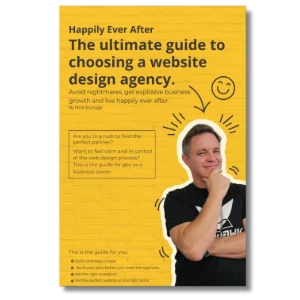
Whatever size of business you are, this is the resource I would point you at first.
Happily Ever After: The Ultimate SME Owner's Guide to Choosing a Website Design Agency walks you through exactly what to ask, how to spot the red flags, how to tell an overpriced proposal from a fair one, and how to protect yourself from expensive mistakes. It is built on fifteen years of watching businesses get it right and watching businesses get it wrong.
It costs nothing. I want every UK and US business owner thinking about a website to have a copy before they sign anything.
What Ambitions AI Actually Charges
Quick Answer: A typical Ambitions AI website costs between £10,000 and £20,000 / $12,500 and $25,000. There are no monthly fees unless you choose for us to host and maintain it. Hosting £400–£1,000 / $500–$1,250 per year depending on traffic. Maintenance £300 / $375 per quarter. No hidden anything.
Here is the part most agencies hide. Our numbers.
Website build: £10,000 to £20,000 / $12,500 to $25,000. Most typical SME projects land right in that range. What pushes the price toward the higher end is straightforward — more pages, more complexity, and more integrations with things like CRMs, booking tools, or payment platforms.
Hosting: £400 to £1,000 / $500 to $1,250 per year, depending on traffic. Optional — you are welcome to take your website away and host it yourself.
Maintenance: £300 / $375 per quarter. A full technical inspection, all security and code updates, and the peace of mind of being able to phone us when something doesn't look right.
Photography: We don't offer photography, and I want to be blunt about this. Budget for it. Stock photography and AI-generated images don't build trust — not with humans, not with Google, and not with AI. Of the 70+ websites we have built, the ones that truly perform all share one thing: real, current photography of real people and real work. Expect to spend £500 to £3,000 / $625 to $3,750 on a proper shoot. Money well spent.
Bundle discount: If you combine your website with other Ambitions AI services (SEO & AEO, Endless Customers Coaching, Reviews Automation, AI Sales & Service Engine), you get 10% off for any two services and 20% off for any three or more. That discount includes the website build.
👉 Full details across every Ambitions AI service on our pricing page . Nothing hidden.
And for Context — A Story from the Very Top End
Before Ambitions AI, I spent part of my career as part of Ford's Global Brand Leadership team.
I remember seeing an invoice land for a single page update on the main Ford website.
£14,500.
One page. One update.
It is tempting to see that number and think: "Someone in Ford's marketing team should have just phoned a freelance copywriter and a developer. They would have done it together for about £1,000." And if you are building a website for your vet practice, your law firm, or your regional service business, that is the right instinct.
But that is not the world Ford lives in.
Every single page on the Ford website is subject to layers of legal, compliance, brand, market, and regional sign-off. A single poorly-worded claim about a vehicle could carry seven-figure consequences in consumer protection, financial services, or automotive regulation. Every page could genuinely drive millions of pounds in new car sales. Sell a few hundred more of any model because the page did its job properly and the investment is transformed.
Ford is not a stupid company. They understand ROI better than almost anyone. £14,500 for a page that protects the company legally and has the potential to sell a few hundred extra vehicles is not the lunacy it first appears.
Between that extreme and a vet practice website, there is an entire continuum. The number that is right for your business is the number that matches your scale, your risk, and your ambition. Nothing more. Nothing less.
Nick's Insight:
In fifteen years and seventy-plus websites, the single pattern I've watched play out again and again is this: businesses who get an average return from their website spend are almost always businesses who skipped the discovery phase. The ones who get a transformative return almost always invested real time up front letting the agency get under the skin of their business. Cheap or expensive is not really the question. The time you put in at the start — that is the question. Every time.
FAQ
How long does it take to build a great website?
Our full-service builds run eight to sixteen weeks from brief to launch. A quicker turnaround can absolutely work — the question is whether the agency has a thorough discovery process that properly draws out everything it needs to know about your business. Without that, any timeline is too short. Our own discovery phase takes about three weeks before we even start designing.
Should I choose a freelancer or an agency?
Freelancers are often better value for a small, simple project (budget, single-location local business, quick launch). Agencies justify their premium when you need coordinated work across design, development, content, SEO, and AI readiness. The wrong choice is paying agency money for freelancer-level work, or expecting agency-level strategy from a one-person team.
What if my budget is smaller than £10,000?
Be honest with yourself about what you're trying to achieve. If you're a new or micro business testing an idea, a £1,500–£3,000 freelance build might be exactly right. If you're an established business with real growth ambition, a cheap site is often a false economy — you'll pay more in the long run replacing it or building on top of it. Read Happily Ever After before committing either way.
Do I need to pay for SEO separately?
Ideally no. Proper agencies build SEO and AI readiness into the website from day one rather than bolting it on afterwards. Be careful of quotes that promise "we'll do SEO later" — that almost always means rebuilding the site. At Ambitions AI, SEO foundations are included in the build. Ongoing content and AI visibility work is a separate service if you want it.
What ongoing costs should I expect after launch?
Hosting (£400–£1,000 / $500–$1,250 per year), maintenance (£100–£500 / $125–$625 per month depending on complexity), and ideally a content flow. That last one is optional on paper but essential if you want Google and AI to keep recommending you. A site without fresh content becomes a digital ghost within a year.
Ready to Get It Right the First Time?
Our pricing is on the pricing page. Nothing hidden. And a free Explore Call costs nothing and commits you to nothing — we'll give you an honest view of what your business actually needs before you spend a penny.

Hi, I'm Nick and I wrote this article.
Pricing articles are the hardest ones to write honestly, because they force you to put your own numbers on the page alongside everyone else's. But hiding prices is the opposite of what AI engines now reward, and frankly it's the opposite of what a business owner deserves when they're trying to make a proper decision. Our pricing is on the pricing page. This article is my attempt to help you judge whether any quote — ours or anyone else's — is right for your business. And if you want a free, no-pitch conversation about what your business actually needs, an Explore Call costs nothing.
More on my page, plus an easy way to get in touch. Find me here →
Keep reading

How Long Does SEO Take to Work? We Tracked Every Month. Here Are the Results.
A dormant luxury bed website. No content. No organic traffic. Five months later, a Google executive walked in and bought a £35,000 bed because of one article.
Read more →
Your Website Is the Trust-Signal Layer of Your Business, and Five Things It Must Do in 2026
Your website used to be a brochure. It is now the layer that tells an AI engine whether your business is real, accountable and worth naming in an answer.
Read more →
Inside a $5K MRR Plumbing Business: The Full Diagnosis
A working plumber doing $5,000 a month in recurring revenue. Solid trade, solid reputation, leaky marketing. Here is the diagnosis, page by page.
Read more →